
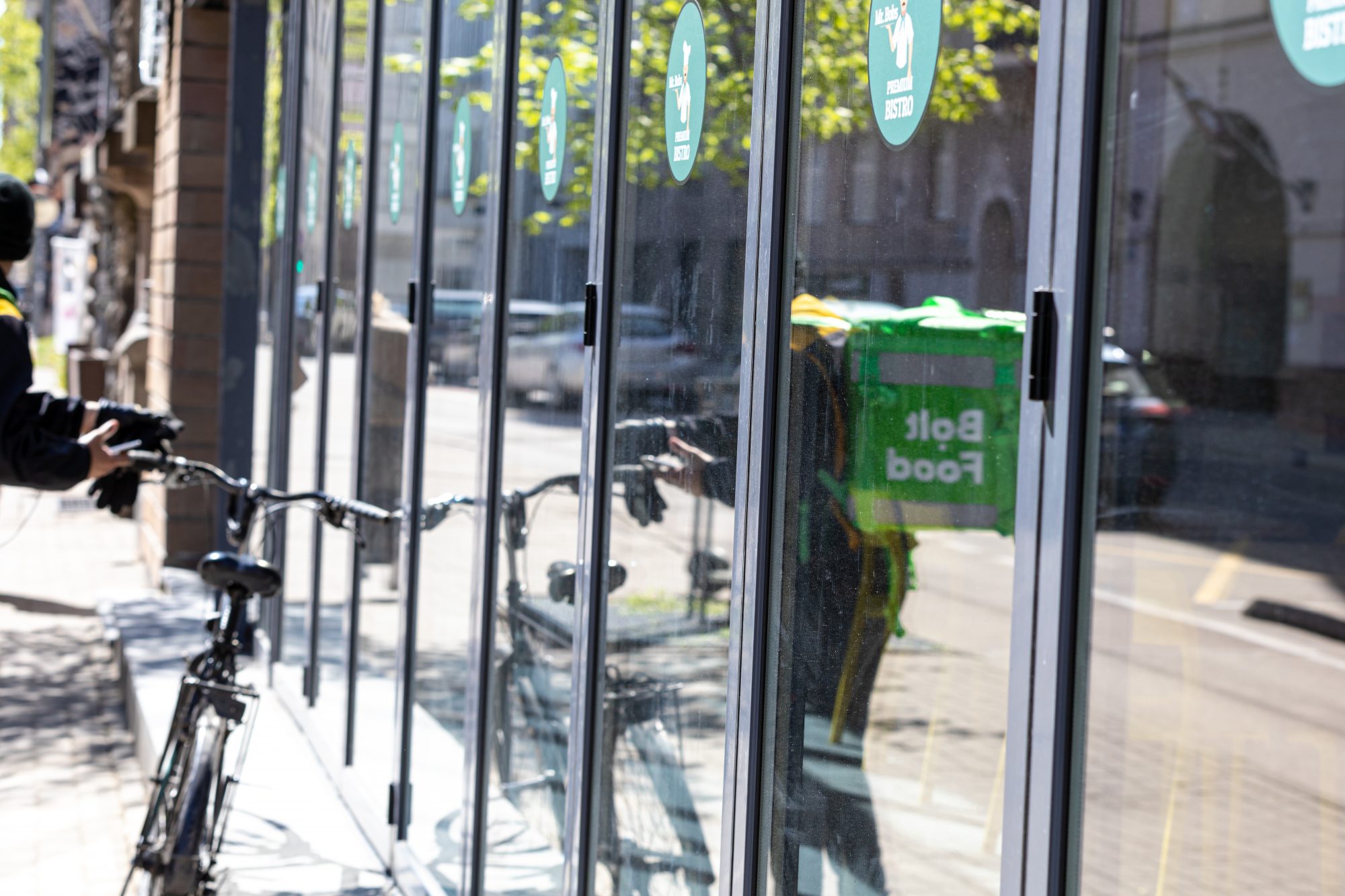
Sociological Types of Precarity Among Gig Workers: Lived Experiences of Food Delivery Workers in Riga.
Ķešāne, I., & Spuriņa, M. (2024). Sociological Types of Precarity Among Gig Workers: Lived Experiences of Food Delivery Workers in Riga. Social Inclusion, 12, Article 7696. https://doi.org/10.17645/si.7696

Theorizing autonomy in the platform economy: A study of food delivery gig workers in Latvia
Existing research on the platform economy highlights a contradiction between autonomy and control. Based on an analysis of online chats and in-depth interviews with food delivery couriers in Riga, the capital of Latvia, we theoretically deepen the explanation of the sense of autonomy identified in algorithmically managed workplaces by analysing how workers’ identity is related to the other identities workers have. Our theorization of autonomy in platform employment is based on Dworkin’s concept of autonomy and uses Merton’s distinction between role-set and multiple roles. Our data demonstrate how couriers’ autonomy is severely limited due to conflicting, algorithmically mediated relationships within their role-set. At the same time, we also show how an ability to control one’s working schedule, emotional well-being and, to some extent, income gives those engaged in food delivery flexibility in dealing with their multiple roles and thus improves the self-governing of their lives.
Ķešāne, I., & Spuriņa, M. (2025). Theorizing autonomy in the platform economy: A study of food delivery gig workers in Latvia. The Sociological Review, 0(0). https://doi.org/10.1177/00380261251330475

Why does class resentment not transform into political action? A study of the food delivery workers’ affective dispositions in Rīga
With digital economy on the rise, there is a growing concern about the poor working conditions of platform workers around the world. While elsewhere in Europe, platform workers have organised strikes, protests and boycotts, in Latvia, growing class resentment has not resulted in any political action. Based on a qualitative study of food delivery workers in Rīga, we find an explanation for this lack of political action in affective dispositions of the workers. We argue that the class resentment has not been mobilised due to several interrelated emotional factors: low social trust in fellow workers, unions and platforms; neoliberal feeling rules of individual responsibility rooted in post-Soviet neoliberalisation; and the affective dispositions couriers hold about themselves, such as low self-confidence, and related shame and fear of disconnection. These emotions silence leadership and any efforts to organise, even if mobilisation is seen as rationally beneficial. Our analysis contributes to studies of platform workers’ mobilisation and the literature on the affective basis of class action by demonstrating how emotional factors can stifle political activism even in the presence of strong class resentment.
Ķešāne, I., & Spuriņa, M. (2025). Why does class resentment not transform into political action? A study of the food delivery workers’ affective dispositions in Rīga. Emotions and Society, 7(3), 383-402. Retrieved Jan 15, 2026, from https://doi.org/10.1332/26316897Y2025D000000082

Affective Governmentality in FoodDelivery Platforms: A Study of BoltFood Riga Push Notifications
The paper uses a governmentality perspective to discuss the issue of control in food delivery platforms through analysis of 4083 push notifications sent by the Bolt Food platform to its couriers in Riga from 2020 to 2023. It examines intensity, rationalization, subjectification, and the use of emojis in push notifications and demonstrates affective governmentality technology to control labor mobility. The analysis contributes to the literature on algorithmic management that focuses predominantly on the control embedded in the platform application. Suppose a platform application is viewed as an algorithmic panopticon in which a worker is free to enter or exit by signing on or off. In that case, other semiautomated control technologies, such as push notifications, are affective persuasive tools for bringing workers into the panopticon that limits workers’ autonomy and control.
Ķešāne, I., & Spuriņa, M. (2025). Affective Governmentality in FoodDelivery Platforms: A Study of BoltFood Riga Push Notifications. Qualitative Sociology Review, Volume XXI Issue 2, 94-112. DOI: https://doi.org/10.18778/1733-8077.21.2.06

Moral Economies of Worth and Symbolic Boundaries in the Construction of Racial Hierarchies in the Platform Economy: An Example of Latvian Food Delivery Gig Workers
This article examines how platform capitalism fosters racialization in Latvia, a country with limited prior experience with diverse immigrant groups but increasing reliance on immigrant labor. Based on unexpected evidence from a study of gig work among food delivery couriers in Riga, Latvia’s capital, this paper explains the construction of racial hierarchies based on “moral boundaries” (Lamont 1992, 2000) in the platform economy. Analysis of the in-depth interviews with food delivery gig workers and publicly available online communication among couriers in online forums allows us to demonstrate how the anxiety of the local couriers about their economic subsistence and social status translates into symbolic boundary work, whereby local couriers argue their moral superiority over immigrant couriers from South Asia and Africa based on work ethic. Our findings shed some light on how platforms’ business model, specifically in the moment of “tightening the belt” (Animento 2024), shapes racialized moral economies of worth in the platform economy.
Ķešāne, I., & Spuriņa, M. (2026). Moral Economies of Worth and Symbolic Boundaries in the Construction of Racial Hierarchies in the Platform Economy: An Example of Latvian Food Delivery Gig Workers. Sociology Compass, Volume 20, Issue 1, January 2026. https://doi.org/10.1111/soc4.70147